
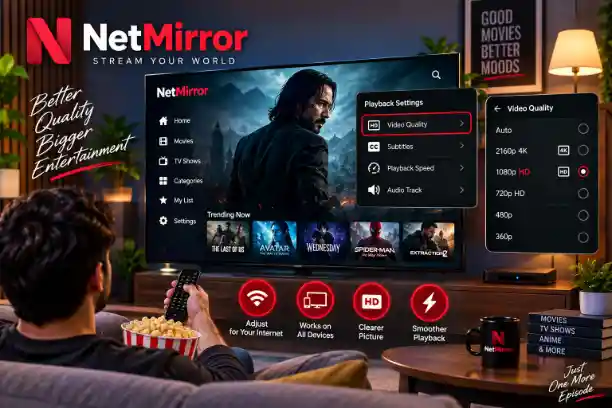
How to Enable Video Quality in Netmirror APK
Adjusting video quality in Netmirror APK allows you to manage playback based on your internet connection and device. If a video looks blurry or you want a clearer picture, you can check the available quality settings in the player. First, open Netmirror APK and play a movie or episode. Tap the video screen to display the playback controls. Then, locate the Settings or gear icon. If a Video Quality or Resolution option is available, open it. You may see a list of available resolutions. Choose an option that matches your internet connection and device. A fast and stable connection can support higher video quality, while a slower connection may provide smoother playback at a lower resolution.
How to Enable Subtitles During Playback
Enabling subtitles during playback is usually simple. This feature is useful for users who want to follow dialogue more easily or watch content in a different language. Start playing your selected movie or episode. Tap the screen once to display the player controls. Look for the CC, subtitle, dialogue, or settings icon. Select it to view the available subtitle languages.
Choose your preferred language from the available options. If a subtitle track is available for the selected video, the captions should appear on the screen during playback. The process may be slightly different on Android TV or a TV box. On these devices, you may need to use the remote control’s directional buttons to access the player settings.
Customizing Subtitle Appearance and Language Preferences
Subtitle appearance may not be equally comfortable for every viewer. Text can look too small on some devices, while white subtitles may be difficult to read over bright scenes. If Netmirror APK or your device provides customization options, you can adjust the subtitle appearance according to your preferences.
Font Size: If subtitles are difficult to read from a distance, choose a larger text size.
Text Color: Some playback systems may provide different text color options. Choose a color that remains easy to see against the video background.
Background Style: A background or text outline can make subtitles easier to read, especially during bright scenes.
Language Preferences: If multiple subtitle languages are available, select the language you prefer. Some content may also provide more than one subtitle track in the same language. These settings can vary depending on the app version and device. If a specific customization option is not available, it may not be supported by your current setup.
Troubleshooting Missing or Unsynced Subtitles
Sometimes subtitles may fail to load or may not stay properly synchronized with the dialogue. You can try a few basic troubleshooting steps to resolve the issue. First, turn the subtitles off and then enable them again after a few seconds. This may reload the available subtitle track. If multiple subtitle tracks are available in the same language, try selecting another track. In some cases, a specific subtitle track may have a synchronization problem.
If the issue continues, try clearing the NetMirror APK cache from your Android device settings. Clearing the cache removes temporary app data and may help with certain loading-related problems. If you are using an external subtitle file, check its name and format. The subtitle file needs to be compatible with the video. If the subtitles are still out of sync, try another available subtitle track or source.
How to Change Video Quality for Smoother Streaming
Manually changing video quality can help provide smoother playback when your internet connection is unstable. Higher resolutions generally use more data and require a stronger connection. Play your movie or episode and tap the screen to display the playback controls. Select the Settings or gear icon. If a Video Quality or Resolution option is available, open it.
You may see Auto, lower-resolution, and higher-resolution options. If the video keeps buffering, try selecting a lower resolution. If your internet connection is fast and stable, a higher resolution can provide a clearer picture. Auto mode can also be useful when your internet speed changes frequently. If the app supports this feature, playback quality may adjust automatically according to the available connection.
Choosing the Right Video Resolution for Your Device
The highest available resolution is not always necessary for every device. When choosing a video quality setting, consider your screen size, internet speed, device capabilities, and available data.
Auto Mode:
The Auto setting can be convenient when network conditions change. If supported, it can adjust playback quality according to the available connection.
Low/Data Saver:
Lower resolutions such as 360p or 480p can be useful for limited data plans and slower connections. On smaller smartphone screens, a lower resolution may still provide a suitable viewing experience.
High Definition:
720p and 1080p can provide a clearer picture on larger smartphones, tablets, and compatible displays. A stable internet connection is recommended for these resolutions.
Ultra HD / 4K:
4K provides a highly detailed picture, but it requires a compatible display, suitable video source, and a strong internet connection. It can also consume considerably more bandwidth when using mobile data. Instead of always choosing the highest setting, select a resolution that matches your current connection and device.
Fixing Video Buffering and Lag Issues
Video buffering can often be caused by an unstable internet connection, high playback quality, or limited device resources. If a video repeatedly stops to load, try lowering the resolution first. For example, if 1080p does not play smoothly, switch to 720p or a lower option. A lower resolution requires less bandwidth and may provide more consistent playback.
If you are using Wi-Fi, restarting your router can also be a useful troubleshooting step. If a VPN is active and streaming becomes noticeably slower, temporarily disconnect from the VPN and test the playback again. Close unnecessary apps running in the background on your device. This can free up memory and processing resources for smoother playback. If the problem occurs with only one particular video, try playing another title. This can help determine whether the issue is related to your internet connection or the specific video source.
Best Practices for an Enhanced Mobile Streaming Experience
A smooth mobile streaming experience depends on more than internet speed. Device performance and playback settings can also affect how videos play. When streaming high-resolution content, a stable Wi-Fi connection can be more practical than mobile data, especially for longer viewing sessions. Keep enough free storage available on your device and avoid running unnecessary applications in the background. Keeping your apps and device software updated can also help maintain normal performance.
If you are using mobile data, choose your video resolution carefully. Higher quality can consume more data, so a lower resolution may be more practical when you have a limited data plan. During long viewing sessions, keep your screen brightness at a comfortable level. If your device provides a night mode or similar display feature, you can enable it according to your surroundings. Most importantly, balance video quality with your internet connection and device capabilities. Choosing a suitable resolution can help reduce unnecessary buffering and provide a more consistent streaming experience.